
5, 6, 7, 8– Who Do We Appreciate?
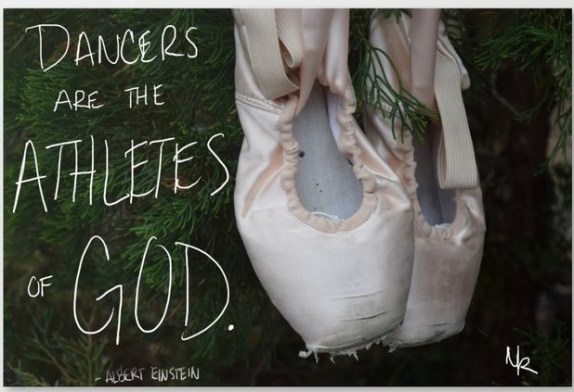
My daughter came home a few days ago pretty worked up for her normally calm, cool, collected self. When she’s worked up it registers as feisty and expressive. (I’ve no idea where she gets that from! 😉) She’d been in an argument with some boys at school where she was defending dance as a sport and dancers as athletes.
For their generation, technology is the end all be all. If it is online, it must be true. Leave it to some young man to Google, “Is dance a sport?” At which point, this was the top search response:
Dance is not a sport due to the fact that everyone can do it. For example, a sport like golf or hockey is a sport because it takes much talent to play either of them.
I’m sorry, say what?! 
I joined my daughter on the feisty fired-up barometer. But being an older, wiser, pre-Internet existing Generation X’er, I decided to investigate what these young men were citing as their overwhelming evidence of a definitive answer.
The article is from the Journal of Dance Education and written by Lindsay Guarino, MFA and professor at Salve Regina University in Rhode Island. Admittedly, I wasn’t willing to pay for the whole article, but the excerpt that can be read online further peaked my interest. First and foremost, I don’t see that actual quote in the excerpt available, but I assume it exists somewhere within the full text (validity, however, is now being questioned).
In reading more than just the top Google search response, Guarino seems to be arguing more for the unique artistic attributes of dance than the athletic prowess associated… almost that dance is historically, culturally, and empirically so important that it cannot be lessoned to the lowly title of mere sport. (Hehehe, I chuckle.)
But one quote and one excerpt from a journal article was not enough to satisfy me, so I kept digging… and it gets even more interesting.
Those who argue that dance is a sport might not be fully aware of the resulting implications. In sports there is always a winner, and usually a clear one. When dance is competitive, and likened to a sport, dancers might not be able to reap the rewards or experience great satisfaction without the ‘win.’

This additional excerpt from the same article goes on to say…
This debate is not black and white, and the edges blur when dancers assert that they are both artists and athletes. The gray areas of the debate expand in the presence of formal dance competitions that designate winners, and in a culture that extolls sporting events with religious fervor.
Wait. Wins and losses, in my experience, are never the sole focus of dance or sport. Sure, the state championship win that one year was amazing, but losing a game or competition doesn’t suddenly render the entire season, individual’s commitment, or team’s efforts fruitless.
Why would it be any different for a dancer who doesn’t win? Statistically speaking, there are always more losers than winners… and yet, people keep playing… and dancing.
And did you know this?
Statistics show that 80 percent of dancers incur at least one injury a year that affects their ability to perform – compared to a 20 percent injury rate for rugby or football players.
At the very least, that is an interesting statistic. Right?
Western culture is, no doubt, a competitive one. And while I like to win too, the article gives short shrift to the roles of both arts and athletics culturally… and the fact that, perhaps, dance is the perfect blend of both.
Just like our competitively minded civilization, we also love our labels and the dichotomy rather than a full spectrum of possibility. Why does dance have to be EITHER this OR that? Why can’t it be both?
But back to the 7th grade debate at hand, I suspect that there is a maturity factor, a gender divide, and that the artistic nature of dance makes it SEEM potentially less physical… less sports-like. That said, I have a thirteen-year-old who dances more than 13 hours each week, equal to or exceeding the one-to-two-hour weekday practices and competitive endeavors (scrimmage, game, meet, etc.) of most community/school-based extracurricular sports. She can plank for more than 8 consecutive minutes and contort her body any manner of ways. She participates in competitive dance competitions… sometimes she wins. Sometimes she doesn’t.
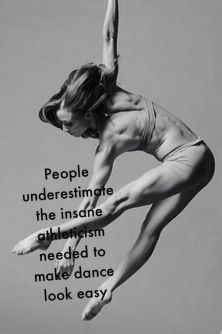 She is a dancer.
And, she is an athlete in every sense of the word.
What I’ve discovered in going down this rabbit hole is how limited our vocabulary is… or is made to be… and how shallow our argument for “being right” is too. A Google search alone doesn’t yield a full answer. Beyond the cleats vs. pointe shoe debate is a far more holistic consideration.
Why do dancers dance? Why do individuals play sports? Both are physical endeavors. Both have historical and cultural context, as well as tradition associated. Both are expressive activities—whether double-digit fouetté turns or a Hail Mary pass. Both elicit powerful audience reaction, support, encouragement, critique, and occasional disappointment. There is individuality and camaraderie.
What if traditional gender roles didn’t skew our perceptions of who we call athletes? What if we defined athletes from an individual’s physical exertion in the name of health and well-being, or from their contribution to their craft and community? What if we focused on the entertainment and engagement value of the arts and athletics in equal measure?
I’m not sure I’ll change the minds of any middle school boys, but my feisty middle school daughter has an equally feisty dance mom cheering her on!
 GlitterBombMom